Guidelines
Guidelines
Using flags to represent languages can be visually appealing but may lead to cultural and regional misunderstandings. It's essential to approach language labelling with sensitivity and clarity to avoid issues such as representing a language with a flag that might not be universally accepted.
Usage
A Flag should:
- Be used to represent regions or nationalities according to the alpha-2 codes to avoid cultural and regional misunderstandings.
- Never be used to represent languages to prevent cultural and regional misunderstandings.
- Always be used in conjunction with a clear, textual label to indicate its meaning.
- Have a consistent size to ensure harmonious visual alignment with other icons and elements.
- Be resized proportionally to prevent distortion, avoiding stretching or squeezing.
- Retain its original colors and appearance without alterations.
- Be used with awareness of cultural and political sensitivities.

Use flags to represent a region or nationality according to the alpha-2 codes of the region.
Language Usage
Using flags to represent languages can be visually appealing but may lead to cultural and regional misunderstandings so please avoid it. It's essential to approach language labeling with sensitivity and clarity to avoid issues such as representing a language with a flag that might not be universally accepted.
When representing languages:
- Use language codes (e.g., "EN" for English, "ES" for Spanish) instead of flags.
- Use text-only labels, either in conjunction with or as an alternative to codes.
- Ensure labels are clear, readable, and accessible.
- Use the native name of the language (e.g., "Español" for Spanish, "Français" for French) either as the main label or an alternative name in brackets if helpful for your users.
- Use a consistent style for language codes, ensuring they are easily recognisable and distinguishable. We recommend ISO 639-1 for general and IETF language tag for more nuanced use.
Best Practices
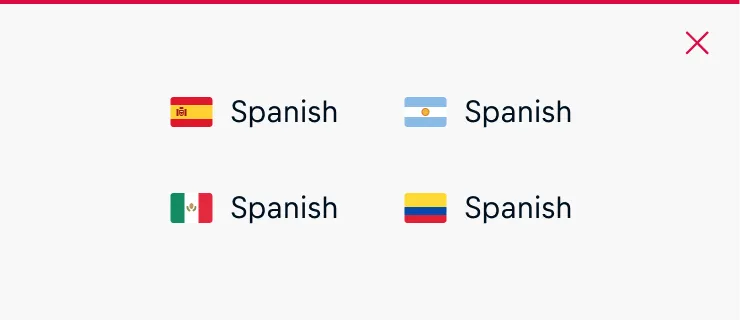
Do not use flags for language labeling. A single language can be spoken in multiple countries with different flags. For example, Spanish is spoken in Spain, Mexico, and many Latin American countries.

Instead of using flags, consider using language codes as a label, such as "EN" for English. This approach avoids cultural and political sensitivities associated with flags.